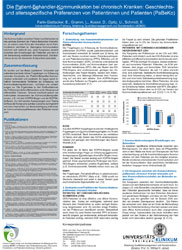
The patient-provider communication in the chronically ill: Sex- and age-specific preferences of male and female patients (PaBeKo project)
The project examined the dialogues between chronically ill male and female patients and the persons treating them (physicians, nurses, therapists). The diseases under investigation were chronic back pain and chronic heart diseases. The main aim of the project consisted of developing a measurement instrument (questionnaire) to capture the preferences of chronically ill persons with regard to the communication with the treatment providers (e.g. desire for a shared dialogue on treatment alternatives, desire for open information of all consequences of the illness, desire for encouraging words from the treatment provider). Furthermore, a questionnaire for the treatment providers should be developed in order to measure their attitudes regarding communication with the patients. Based on these instruments, in the further course of the project, the different preferences of different patient groups (e.g. men and women) were considered. Building on the results gained, moreover, a provider training program for the consideration of the patients' communication wishes was conceived, which should lead to an improvement of the patient-provider communication.
Background and aims
The project "Patient-provider communication in the chronically ill: Sex- and age-specific preferences of male and female patients (short: PaBeKo) deals with the theme of the patient-provider communication in the chronically ill. Communication represents the central element of patient-provider relationship. A successful communication is distinguished through the fact that congruence exists between the expectations and wishes of the patients regarding the communication on the one hand and the corresponding attitudes of the treatment provider on the other. It can be expected that a functioning patient-provider communication exerts a positive influence on adherence, treatment satisfaction and health-related treatment outcomes. Accordingly, treatment providers should shape their patient dialogues flexibly in accordance with the individual beliefs and needs of the patients. The objectives of our projects can be structured according to the following content-based themes:
- The qualitative measurement of patient preferences and treatment provider attitudes on patient-provider communication.
- The development and methodological testing of measurement instruments for capturing the patients' communication preferences, the treatment providers' communication behaviour and the treatment providers' attitudes towards communication.
- Description of the communication preferences and the fit between patient preferences and physician behaviour
- Prediction of the communication preferences of patients under special consideration of gender.
- Analysis of the influence of communication and further physician-patient relationship variables on the outcome of the treatment
- Conception of materials for treatment provider training on the basis of a web-based evaluation program for a questionnaire on patients' communication preferences (KOPRA questionnaire)
Results
In the framework of two qualitative preliminary studies as well as in two quantitative studies with one and three measurement time points, respectively, data were gathered from over 1500 rehabilitees with chronic back pain or chronic ischemic heart disease. The results of the project were published in eight academic journals. Furthermore, the project results were presented to the public in 22 presentations at expert conferences. In the following, a brief outline of the essential project findings is provided.
Three assessment instruments on patient-physician communication were developed, which fulfil important methodological quality criteria and appear to be well suited to use in empirical studies:
- The KOPRA questionnaire for measuring patients' communication preferences,
- The KOVA questionnaire for measuring the communication behaviour of the physician as perceived by the patient, and
- The KOMBEIN questionnaire for measuring the communication-related attitudes of the treatment provider.
The four dimensions which the respective instruments measure are:
- Patient participation and patient orientation (e.g. "...weighing up the advantages and disadvantages of different treatment options together with you.")
- Effective and open communication (e.g. "...always telling you everything about your illness even when it is unpleasant.")
- Emotionally supportive communication (e.g. "...bolstering you in the conversation.")
- Communication about personal circumstances (e.g. "...exchanging a few private words with you.")
It should be particularly emphasised that the aforementioned three instruments are identical in terms of content and thus appear to be well suited to congruence investigations. In the KOPRA questionnaire, the treatment provider behaviour (e.g., "weighing up the advantages and disadvantages of different treatment options together with the patients") is presented and the patient is asked to indicate how important this behaviour is to him/her. In the KOVA questionnaire, the patient should indicate after the treatment to what extent the treatment provider showed this behaviour, and in the KOMBEIN questionnaire, the treatment provider is asked how important he/she believes this behaviour of the treatment provider to be.
The usefulness of the instruments is also demonstrated in the fact that the procedure has now been adopted by other work groups. For instance, the Scientific Institute of Registered Haematologists and Oncologists (WINHO) has measured the communication of N=1860 oncology patients using the KOPRA questionnaire; an application of the KOVA questionnaire is planned there for 2012.
The descriptive findings which were gained with the newly developed instrument show that for patients with chronic back pain, the patient participation and a clear and transparent communication are particularly important. This is followed by the emotionally supportive communication and finally the communication about personal circumstances. The less important the communication area, the greater the dispersion of patient preferences. In other words, precisely in areas which are on average seen as less important, there are clearer differences between patients, meaning that here, a particular flexibility is required of the treatment provider. For instance, a quarter of patients state that it is not important to them that the physician sometimes speaks to them on a personal level. 12.9%, by contrast, find this very important or even extremely important.
The fit between the communication preferences of the patient and the communication behaviour of the physician is generally fairly high. For instance, many treatment providers show to a clear extent the behaviour (desired by the patient) of discussing and determining the therapeutic measures together with the patient and asking the patient what has helped him/her. Discrepancies were most likely to be apparent in the area of "effective and open communication". For instance, the patients wish to be informed about further treatment at the end of the initial treatment and wish for an open communication to take place, even about unpleasant matters. The latter behaviour in particular, however, is not shown particularly clearly by the physicians according to the patients' perception.
The differences between patients with chronic back pain and with chronic-ischemic heart disease in terms of communication preferences are fairly small. For patients with chronic-ischemic heart disease, the communication about personal matters is somewhat more important, while the effective/open communication and patient participation is somewhat less important than for patients with chronic back pain. Similarly, in terms of the perceived communication behaviour of the physician – and consequently also the matching between patient preferences and treatment provider behaviour – there are barely any differences between the two illnesses. According to the patients' perception, the physicians most clearly show emotionally supportive behaviour, followed by effective and open communication as well as patient participation. In the area of communication about personal circumstances, the matching is the lowest, which lies both in the fact that patients do not formulate such clear preferences here and that the physicians show the corresponding behaviour more rarely.
The assumption that gender is a relevant influencing factor of communication preferences was only partially confirmed. In multivariate analyses controlling for a multitude of confounders, gender was only significant for chronic back pain and only for one of the four communication dimensions: Female back pain patients find an emotionally supportive communication to be particularly important. The most important predictors of communication preferences are age (younger persons find patient participation and effective /open communication to be particularly important and communication about personal circumstances less important) and psychological variables such as self-efficacy and control orientation. In part, income is also important: Patients with a better financial situation prefer participatory and patient-oriented physician behaviour to a greater extent.
With the data gathered, we were able to demonstrate a relationship between patient-provider communication and further physician-patient relationship variables on the one hand and the outcome of the treatment on the other. Even after adjusting for a multitude of sociodemographic, medical and psychological influencing factors, the relationship variables in patients with chronic back pain show a statistically significant association with improvements in health status (pain, impairments in activities, quality of life) following a rehabilitation measure. In the medium term (6 months after the rehabilitation), this association is even clearer than in the short term at the end of rehabilitation. A relationship that is perceived by the patient as good and trusting is associated with clearer improvements.
The specific influence of the communication aspects which we measure with our newly developed communication questionnaires is, however, highly complex and does not follow a simple pattern. It appears to be the case that, for instance, participatory communication behaviour of the treatment provider is relevant for the prediction of the development of the state of health following the rehabilitation, but that its influence on the outcome is mediated by the general satisfaction with the physician, or rather the trust in the physician. This indirect, positive influence is in contrast to a direct negative influence, which is potentially attributable to the lack of consideration of the specific preferences of the patient. Further research works on the detailed analyses of the causal paths between patient-physician communication and treatment outcome are yet to be conducted. The results of the PaBeKo project indicate that this task would be worthwhile, as the relationship variables in their entirety show an association to the outcome, which appears to be independent of other influencing factors.
An excerpt of the project-related publications / presentations categorised according to themes
1. The qualitative measurement of patient preferences and treatment provider attitudes regarding patient-provider communication
Written publications
- Gramm, L., Kosiol, D., Opitz, U. & Farin, E. (2011). Qualitative Erfassung von Patientenpräferenzen und Behandlereinstellungen zur Patient-Behandler-Kommunikation: eine Fokusgruppen-Studie. Zeitschrift für Medizinische Psychologie, 20(2), 76-87.
Conference/congress contributions
- Kosiol, D., Gramm, L., & Farin, E. (2009). Die Patient-Behandler-Kommunikaton: Kommunikationsbezogene Präferenzen von chronisch kranken Patienten in der Rehabilitation. DRV-Schriften, 83, 67-68.
2. The development and methodological testing of measurement instruments to capture patients' communication preferences, treatment providers' communication behaviour and treatment providers' attitudes towards communication
Written publications
- Farin, E., Gramm, L., & Kosiol, D. (2011). Development of a questionnaire to assess communication preferences of patients with chronic illness. Patient Education and Counseling, 82(1), 81-88.
- Farin, E., Gramm, L., Schmidt, E. (2011). The congruence of patients' communication preferences and physicians' communication behavior in cardiac patients. Journal of Cardiopulmonary Rehabilitation and Prevention 31(6), 349-357.
- Farin, E., Gramm, L., Schmidt, E. (2012). Taking into account patients' communication preferences: Development of an instrument and descriptive results in patients with chronic back pain. Patient Education and Counseling, 86, 41-48.
Conference/congress contributions
- Farin-Glattacker, E., Baumann, W. (2011). Psychometrische Eigenschaften des KOPRA-Fragebogen zu Kommunikationspräferenzen bei onkologischen Patienten. In: 10. Deutscher Kongress für Versorgungsforschung. 18. GAA Jahrestagung. Köln, 20.-22.10.2011. Düsseldorf: German Medical Science GMS Publishing House; 2011. http://www.egms.de/en/meetings/dkvf2011/11dkvf183.shtml
- Farin-Glattacker, E., Gramm, L. & Schmidt, E. (2011). Die Berücksichtigung der Kommunikationspräferenzen von chronisch kranken Patienten durch Ärzte: Instrumentenentwicklung und deskriptive Befunde. Kongress der DGSMP und der DGMS in Zusammenarbeit mit dem MDK, 22.-23.9.2011 in Bremen. Das Gesundheitswesen 73(8/9), 553.
- Farin-Glattacker, E., Gramm, L. & Schmidt, E. (2011). Die kommunikationsbezogenen Einstellungen von BehandlerInnen in der medizinischen Rehabilitation. DRV-Schriften, 93: 172-173 (20. Rehabilitationswissenschaftliches Kolloquium,14.-16.3.2011 in Bochum).
- Farin, E., Gramm, L., Kosiol, D. (2009). Die Entwicklung eines Fragebogens zu den Kommunikationspräferenzen von Patienten mit chronischen Krankheiten: der KOPRA-Bogen. 8. Deutscher Kongress für Versorgungsforschung, am 2.10.2009 in Heidelberg, Zeitschrift für Allgemeinmedizin, Sonderausgabe DEGAM/DKVF 2009, 83.
- Gramm, L., Kosiol, D., & Farin, E. (2010a). Evaluation der deutschen Version des Fragebogens „Perceived efficacy in patient-physician interactions" (PEPPI). DRV Schriften, 88, 108-110.
- Schmidt E., Gramm L., Farin-Glattacker E. (2011b). Die Messung von Kommunikationspräferenzen chronischer Schmerzpatienten im Klinikalltag 2011 (7. Workshopkongress der Fachgruppe Klinische Psychologie/Berlin/DGPs).
3. Description of communication preferences and the fit between patient preferences and physicians' behaviour
Written publications
- Farin, E., Gramm, L., Schmidt, E. (2011). The congruence of patients' communication preferences and physicians' communication behavior in cardiac patients. Journal of Cardiopulmonary Rehabilitation and Prevention 31(6), 349-357
- Farin, E., Gramm, L., Schmidt, E. (in press). Taking into account patients' communication preferences: Development of an instrument and descriptive results in patients with chronic back pain. Patient Education and Counseling (epub ahead of print: http://dx.doi.org/10.1016/j.pec.2011.04.012)
- Schmidt, E., Gramm, L. & Farin, E. (im Druck). Kommunikationspräferenzen chronischer Rückenschmerzpatienten in der medizinischen Rehabilitation. Der Schmerz.
Conference /congress contributions
- Farin-Glattacker, E. (2011). Die Kommunikation zwischen PatientInnen und BehandlerInnen in der Gesundheitsversorgung. Vorlesungsreihe „Methoden der Versorgungsforschung", 13.7.2011 in Freiburg.
- Farin-Glattacker, E., Gramm, L. & Schmidt, E. (2011). Übereinstimmung von patientenseitigen Kommunikationspräferenzen und dem Kommunikationsverhalten der Ärzte bei Patienten mit chronisch-ischämischer Herzkrankheit, Herzmedizin, 2011; 2011 (2): 84-84 (DGPR-Kongress, 2.-3.6.2011 in Berlin).
- Farin, E., Gramm, L., Kosiol, D. (2010). Die Präferenzen chronisch Kranker im Hinblick auf die Kommunikation mit BehandlerInnen. 18. Jahrestagung der Deutschen Gesellschaft für Psychosomatische Medizin und Ärztliche Psychotherapie (DGPM), 61. Arbeitstagung des Deutschen Kollegiums für Psychosomatische Medizin (DKPM). 17. - 20.3.2010 in Berlin, Psychologische Medizin (Sonderausgabe), 43-44.
- Gramm, L., Kosiol, D., & Farin, E. (2010b). Kongruenz von patientenseitigen Kommunikationspräferenzen und arztseitigem Kommunikationsverhalten als Prädiktor des Behandlungserfolgs bei Patienten mit chronischem Rückenschmerz. Monitor Versorgungsforschung, Sonderausgabe 9. Deutscher Kongress für Versorgungsforschung/Bonn/DNVF 30.09.2010, 36.
- Gramm, L., Kosiol, D., & Farin, E. (2009). Die Patient-Behandler-Kommunikation: Kommunikationsbezogene Präferenzen chronisch kranker Patienten in der Rehabilitation. Gesundheitswesen, 71, A172.
- Gramm, L., Kosiol, D., & Farin, E. (2009). Patient-professional communication: Congruence of patients' preferences and professionals' attitudes. 5th World Congress of the International Society of Physical and Rehabilitation Medicine (ISPRM) vom 13.bis 17.Juni 2009 in Istanbul.
- Kosiol, D., Gramm, L., & Farin, E. (2010). Kommunikationspräferenzen chronisch kranker Patienten in der medizinischen Rehabilitation. DRV-Schriften, 88, 220-222.
4. Predication of communication preferences of patients under special consideration of gender
Written publications
- Farin, E., Gramm, L., Schmidt, E. (submitted) Predictors of communication preferences in patients with chronic low back pain. Pain Medicine.
Conference/congress contributions
- Gramm L., Schmidt E., Kosiol D., Farin-Glattacker E. (2011). Prädiktoren der Kommunikationspräferenzen von Patienten mit chronischem Rückenschmerz DRV-Schriften, 93: 153-155 (20. Rehabilitationswissenschaftliches Kolloquium/ 14.-16.3.2011 in Bochum/ DRV Bund und DRV Knappschaft-Bahn-See), Deutsche Rentenversicherung Bund (Hrsg)
- Gramm L., Schmidt E., Kosiol D., Farin-Glattacker E. (2011). Predictors of communication preferences of patients with chronic ischemic heart disease. Journal of Rehabilitation Medicine, 43 (9): 844 (2nd Baltic and North Sea Conference on Physical and Rehabilitation Medicine)
5. Analysis of the influence of communication and further physician-patient relationship variables on the outcome of treatment
Written publication
- Farin, E., Gramm, L., Schmidt, E. (in press). The patient-physician relationship in patients with chronic low back pain as a predictor of outcomes after rehabilitation. Journal of Behavioral Medicine.
6. Conception of materials for treatment provider training on the basis of a web-based evaluation program for a questionnaire on patients' communication preferences (KOPRA questionnaire)
Conference/congress contributions
- Schmidt E., Gramm L., Farin-Glattacker E. (2011a). Die Messung von Kommunikationspräferenzen chronischer Schmerzpatienten im Klinikalltag 2011 (7. Workshopkongress der Fachgruppe Klinische Psychologie/Berlin/DGPs).
Links
Current project information and a list of the participating clinics can be found under: www.aqms.de
< QSFK - Trojan | Patient preferences ... - Thürmann >