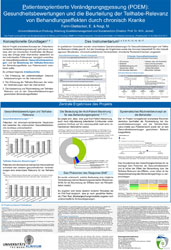
Patient-oriented change measurement: Health evaluations and the assessment of participation relevance of treatment effects by chronically ill persons (POEM project)
The project was concerned with the question of how the success of the treatment of chronically ill patients can be measured oriented towards the ideas and experiences of the patients. To this aim, a questionnaire was developed in which the patients can indicate at the beginning of their treatment which health improvements they wish for through the therapy. Following the treatment, it was measured which consequences the effected changes have for the everyday life of the respective patient. With the aid of such a questionnaire, which could be implemented into routine care in clinics, it would be possible to involve patients in the long term in the planning and success evaluation to a greater extent than has thus far been the case. Patients with three different illnesses took part in the study: breast cancer, chronic heart diseases, and chronic back pain.
Background and aims
General developments in the direction of a patient-centred health care provision have affected methodological research areas such as change measurements and lead to the demand that – in particular with chronic diseases – it should be the individual patient who evaluates his/her health change. In the project "Patient-oriented change measurement: Health evaluations and assessment of the participation relevance of treatment effects by chronically ill persons", a concept of patient-oriented change measurement was developed: the so-called POEM concept. The concept should not replace the usual procedure in determining intervention effects, but merely extend it, by introducing into the survey design, through additional questions and evaluations, aspects of individualisation and significance rating as judged by the patient. The POEM concept plans the following three work steps:
- The measurement of the patients' health evaluations before the intervention, i.e. the measurement of patient preferences in terms of possible health improvements,
- The measurement of the participation relevance of the changes experienced after the intervention,
- The evaluation and feedback of the effects weighted on the health evaluations as well as the participation relevance.
Moreover, in the evaluation, different research questions were examined which empirically analyse the importance of the patient-oriented change measurement.
After a running time of three years, the project ended on 28.02.2011.
Conceptual foundations of patient-oriented change measurement:
The instruments were developed in a patient-oriented manner in qualitative preliminary studies (patient focus groups, cognitive pretests). In this respect, different possibilities for operationalising health evaluations (visual analog scale, willingness-to-pay method, rating scale, ranking method) and participation relevance judgements were examined in terms of comprehensibility and acceptance. To this aim, in the framework of a prospective study with three measurement time points (beginning of rehab, end of rehab, 6 months after end of rehab), data from N=312 patients with breast cancer, N=328 patients with chronic-ischemic heart disease and N=189 patients with chronic back pain were gathered. A systematic feedback mode enables feedback of the treatment effects weighted on the health evaluations as well as the participation relevance. The evaluations can take place on an individual or group basis.
Measurement of health evaluations before the intervention
For all outcome areas of interest and measured in the study (e.g. mobility, pain, emotional well-being), it is measured at the beginning of the treatment which benefit the individual patient links to the respective health improvement. Our studies conducted in the framework of the project led to the result that for the measurement of health evaluations, a VAS and a ranking task are particularly advantageous. In terms of the VAS method, the rehabilitees are asked, on one line that shows a scale from 0 to 100, to estimate their current health state as well as various health scenarios (one for each relevant outcome area) with an improved health state that can possibly be reached through the rehabilitation. In the ranking task, the participants have to place the outcome areas in a ranking sequence in terms of their subjective importance. It appears to be important that the health evaluations are measured in such a way that they correspond in terms of content to the endpoints measured in the study, enabling the two to be related to one another.
Measurement of participation relevance of experienced health changes
In order to be able to depict the benefit of a change experienced by the individual patient in his or her everyday life, the patient is asked, following the intervention,
- whether he/she experienced any discernible development in terms of the relevant outcome areas and – if so –
- how much this improvement has concretely improved his participation in terms of coping with everyday life.
Thus, while the health evaluations before the treatment depict the importance or anticipated individual benefit of a possible treatment goal (e.g. pain reduction), the participation relevance judgement measures the actual benefit for individual participation experienced after the intervention. With the judgement of participation relevance, perceived participation improvements are measured, which the patient attributes to changes in basic areas brought about by the treatment (body structures, bodily functions, basic activities).
Results on psychometric parameters, descriptive results as well as the content-based questions examined regarding patient-oriented change measurements can be found in the project publications listed below.
Feedback of weighted treatment effects and participation relevance
In the project, a possible weighting schema was developed: The more important a health area is to the patient, and the higher the effect in this outcome area (measured with established assessment instruments), or rather the participation relevance of the effect, the higher the general evaluation of the treatment success can be estimated to be. The health improvements weighted in this manner provide the information of the areas in which preferred health improvements (measured according to effect sizes and the evaluation of participation improvement) were actually achieved. It is optimal if, in an area that is very important to the patient, high individual effect sizes and a clear participation improvement were reached. It is particularly critical if, in an area that is very important to the patients, neither effects in the indirect change measurement with outcome instruments nor improvements in the perceived participation were achieved.
Recommendations
For researchers who wish to realise a quantitative research approach with the measurement of change in health state of chronically ill persons and in this respect implement the POEM concept, in summary, the following recommendations can be made: With regard to the respective outcome areas of interest in the study (which will generally correspond to the scales of the implemented outcome instruments), items on health evaluation (e.g. visual analog scale or ranking tasks) and items on perceived participation relevance should be constructed. The implementation of a qualitative and/or quantitative pretest to determine basic methodological quality criteria of these items (e.g. comprehensibility, retest reliability) can be recommended. The items on health evaluation should be presented to the patients at the time point before the interventions, the items on participation relevance after the intervention. With the evaluations described by the authors, it is then possible – both on the individual and group level – to supplement the usual analyses with patient-oriented evaluations, in which the evaluation of the achieved effects is extended by analyses weighted according to the preferences and success perceptions of the patient. Consequently, the goal is ultimately pursued of reaching a "triangulation" of different perspectives, which – based on different evaluators (patient, treatment provider, but where applicable also family members and service providers) – depicts a balanced and comprehensive evaluation of the success of an intervention.
Current project information and a list of the participating clinics can be found at:
Project publications
Written publications
- Farin, E. & Meder, M. (2010). Personality and the physician-patient relationship as predictors of quality of life of cardiac patients after rehabilitation. Health and Quality of Life Outcomes, 8: 100
- Farin, E. & Nagl, M. (online first). The patient-physician relationship in patients with breast cancer: descriptive results and influence on quality of life after rehabilitation. Quality of Life Research. http://dx.doi.org/10.1007/s11136-012-0151-5
- Farin, E. (2008). Patientenorientierung und ICF-Bezug als Herausforderungen für die Ergebnismessung in der Rehabilitation. Rehabilitation, 47, 67-76.
- Farin, E., Nagl, M. (2011). Patient-oriented outcome measurement in rehabilitation: Conceptual basis and empirical evidence. International Journal of Rehabilitation Research, 1 (4), 696-704.
- Meder M. & Farin, E. (2011) Gesundheitsbewertungen bei Patienten mit chronisch-ischämischer Herzkrankheit. Die Rehabilitation, 50, 522-530.
- Meder, M. & Farin, E. (2009). Akzeptanz und Verständlichkeit verschiedener Methoden der Gesundheitsbewertung bei chronisch Kranken: Willingness to pay, visuelle Analogskala und verbale Ratingskala. Gesundheitswesen, 71(11), e1-e10.
- Nagl, M. & Farin, E. (2011). Die Entwicklung eines Instruments zur Erfassung der Teilhabe-Relevanz von Behandlungseffekten bei chronisch Kranken: Retest-Reliabilität und deskriptive Ergebnisse. Die Rehabilitation, 50, 379-389.
- Nagl, M. & Farin, E. (in press). Response shift in quality of life assessment in patients with chronic back pain and chronic ischaemic heart disease. Disability and Rehabilitation. Online first: http://dx.doi.org/10.3109/09638288.2011.619616
- Nagl, M., Farin, E. (2012). Congruence or discrepancy? Comparing patients' health valuations and physicians' treatment goals for rehabilitation for patients with chronic conditions International Journal of Rehabilitation Research, 35(1), 26-35.
- Farin, E., Nagl, M. (2011). Patient-oriented outcome measurement in chronic diseases: Conceptual basis and empirical evidence. International Journal of Person Centered Medicine, 1 (4), 696-704.
Conference/congress contributions
- Farin E, Kriesch M: Patientenorientierte Veränderungsmessung: Akzeptanz und Verständlichkeit verschiedener Methoden zur Erfassung von Gesundheitsbewertungen German Medical Science GMS Publishing House, 2008; P5.2 (Deutscher Kongress für Versorgungsforschung vom 17.10.08 in Köln, DNVF)
- Farin E, Meder M: Welche Methode empfiehlt sich zur Erfassung von Gesundheitsbewertungen (health valuations) chronisch Kranker? DRV Schriften, 2010; 88: 222-224 (19. Rehabilitationswissenschaftliches Kolloquium/08.03.2010 in Leipzig/Deutsche Rentenversicherung Bund), Deutsche Rentenversicherung Bund (Hrsg)
- Farin E, Nagl M: Konzeptionelle Grundlagen einer patientenorientierten Veränderungsmessung: Das POEM-Konzept Gesundheitswesen, 2011; 73 (8/9): 553 (Kongress der DGSMP und der DGMS in Zusammenarbeit mit dem MDK/Bremen/DGSMP, DGMS, MDK).
- Farin-Glattacker E, Nagl M: Die Bedeutung der Arzt-Patient-Beziehung für die Lebensqualität nach einer onkologischen Rehabilitation DRV-Schriften, 2011; 93: 403-404 (20. Rehabilitationswissenschaftliches Kolloquium/ 14.-16.3.2011 in Bochum/ DRV Bund und DRV Knappschaft-Bahn-See), Deutsche Rentenversicherung Bund (Hrsg).
- Kriesch M, Farin E: Willingness to pay als Methode zur Erfassung von Patientenpräferenzen in der Ergebnisbewertung: Verständlichkeit und Akzeptanz DRV-Schriften, 2009; 83: 95-97 (18. Rehabilitationswissenschaftliches Kolloquium, vom 10.03.2009 in Münster, Deutsche Rentenversicherung Bund), Deutsche Rentenversicherung Bund (Hrsg)
- Nagl M, Farin E: Patientenorientierte Veränderungsmessung: Die Stabilität der von chronisch Kranken wahrgenommenen Teilhabe-Relevanz einer gesundheitlichen Veränderung Monitor Versorgungsforschung, 2010: 43 (9. Deutscher Kongress für Versorgungsforschung/Bonn/DNVF 01.10.2010)
- Nagl M, Farin E: Response shift in quality of life assessment in patients with chronic back pain and chronic ischemic heart disease J Rehabil Med, 2011; 43 (9): 846 (2nd Baltic and North Sea Conference on Physical and Rehabilitation Medicine/Vilnius, Litauen/Baltic and North Sea Forum for Physical and Rehabilitation Medicine (BNF/PRM))
- Nagl M, Farin-Glattacker E: Patientenseitige Gesundheitsbewertungen und arztseitige Zielfestlegungen in der Rehabilitation: Übereinstimmung und Diskrepanz. DRV-Schriften, 2011; 93: 147-148 (20. Rehabilitationswissenschaftliches Kolloquium/ 14.-16.3.2011 in Bochum/ DRV Bund und DRV Knappschaft-Bahn-See), Deutsche Rentenversicherung Bund (Hrsg)
- Nagl, M., Farin, E: Teilhabe-Relevanz-Bewertungen als zentrales Konzept einer patientenorientierten Veränderungsmessung bei chronisch Kranken. Vortrag bei der 26. Jahrestagung der Deutschen Gesellschaft für Neuropsychologie, 22.-24. September in Aachen
- Schulz M, Nagl M, Farin E: Einflussfaktoren der Akzeptanz eines Patientenfragebogens zur Lebensqualität Arzneimittelversorgung: Qualität und Effizienz. Abstracts, 2011; 2011: 53-54 (10. Deutscher Kongress für Versorgungsforschung/Köln/Deutsches Netzwerk Versorgungsforschung und Gesellschaft für Arzneimittelanwendungsforschung und Arzneimittelepidemiologie), Deutsches Netzwerk Versorgungsforschung und Gesellschaft für Arzneimittelanwendungsforschung und Arzneimittelepidemiologie (Hrsg).
< Module four - period 1 | heiQ - Schwarze >