Influence of Shared Decision Making on the motivation to tackle job-related problems during work-related medical rehabilitation
Background
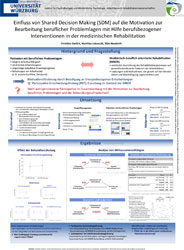
Shared decision making (SDM) can contribute, in the rehabilitation context, to an optimized and structured integration of the patient into therapy-related decisions, foster the motivation to deal with disease-relevant issues and increase the satisfaction with the measure. One possibility for the application of the SDM concept is in the framework of vocationally oriented/work-related medical rehabilitation (Work MR). In this respect, the rehabilitation process is more strongly oriented to health-relevant factors of working life and focused on professional problems and burdens. Motivational problems on the part of the patients are frequently reported in such work-related measures. An interaction of the treatment provider with the patient based on shared dialogue may contribute to reducing these problems.
Research question and methods
The aim of the research project was to integrate the approach of shared decision making into the indication dialogue regarding vocationally oriented measures and to examine the effect on patients’ motivation to deal with work-related problems as well as their satisfaction with the indication dialogue and the decision made therein. As no previous experiences were available in terms of the structured integration of patients into decision making in the Work MR context, the SDM approach was newly introduced into the participating rehabilitation centers. Physicians and therapists were trained in involving patients with particular work-related problems into the decision making process using the defined SDM process steps (Simon et al. 2008). Data were collected in two phases (time-delayed control and intervention phase). 142 patients were surveyed before and 141 after the introduction of the approach in two orthopaedic rehabilitation clinics with regard to their motivation to deal with vocational problems and their satisfaction with the indication dialogue. At the end of the rehabilitation as well as 12 months after the rehabilitation measure, information on satisfaction with the Work MR measure was gathered.
Results
No significant differences were found between the two cohorts with regard to motivation and satisfaction. From the patient perspective, the degree of participatory involvement did not fundamentally differ between cohorts (no significant difference in the SDM-Q-9 questionnaire). However, in both cohorts, the SDM-Q-9 values stretched almost across the whole value range (0 to 100) of the questionnaire.
Therefore, for further analyses, four patient-oriented interaction forms were differentiated, based on a latent-class analysis of the responses in the SDM-Q-9.
- Shared decision making. Patients reported a structured inclusion in the treatment decision in accordance with all nine defined process steps of shared decision making.
- A patient-oriented interaction form in which patients felt involved in the decision making process, but without a structured integration being achieved as is characteristic for the approach of shared decision making (6 of the 9 SDM process steps were experienced).
- A patient-oriented interaction form in which the patients did not feel involved in the decision-making process (5 of the 9 SDM process steps were experienced).
- No patient-oriented interaction.
The differentiation of the four types of patient orientation provided no indications that in the context of Work MR, patients who experience shared decision making are more motivated to tackle their vocational problems. By contrast, there is clear evidence that patients who experienced patient-oriented interaction forms and in particular shared decision making are more satisfied with the indication dialogue and the decision made therein.
References:
- Simon, D., Loh, A. & Härter, M. (2008). Grundlagen der partizipativen Entscheidungsfindung und Beispiele der Anwendung in der Rehabilitation. Rehabilitation, 27, 84-89.
Project-related publications:
- Neuderth, S., Gerlich, C. & Vogel, H. (2008). Einfluss von Shared Decision Making auf die Motivation zur Bearbeitung beruflicher Problemlagen mit Hilfe berufsbezogener Interventionen in der medizinischen Rehabilitation. Posterpräsentation auf der Auftaktveranstaltung zum Förderschwerpunkt Versorgungsnahe Forschung: Chronische Krankheiten und Patientenorientierung am 03./04.04.2008 in Erkner.
- Gerlich, C. Botterbusch, I. & Neuderth, S. (2008). Shared Decision Making im Vorfeld berufsbezogener Interventionen in Rehabilitationskliniken. Vortrag auf der Tagung „Patientenorientierung in der Rehabilitation", veranstaltet durch das Netzwerk Rehabilitationsforschung in Bayern e.V. und das Zentrum Patientenschulung am 07.11.2008) in Würzburg.
- Gerlich, C., Neuderth, S. & Botterbusch, I. (2008). Einfluss von Shared Decision Making auf die Motivation zur Bearbeitung beruflicher Problemlagen in der medizinischen Rehabilitation.
- Mündlicher Beitrag in der Innovationswerkstatt im Rahmen des 18. Rehabilitationswissenschaftlichen Kolloquiums vom 09.03.-11.03.2009 in Münster: DRV-Schriften, Band 83, S. 64- 66.
- Lukasczik, M., Gerlich, C. & Neuderth, S. (2010). Förderung der Motivation zur Auseinandersetzung mit arbeits- und berufsbezogenen Problemlagen in der medizinischen Rehabilitation durch Partizipative Entscheidungsfindung. Abstractband des Gemeinsamen Kongresses der Deutschen Gesellschaft für Medizinische Psychologie und der Deutschen Gesellschaft für Medizinische Soziologie, Gießen, September 2010. Zeitschrift für Medizinische Psychologie, 19, 40.
- Gerlich, C., Lukasczik, M. & Neuderth, S. (2011). Erfassung der Partizipativen Entscheidungsfindung mit dem PEF-FB-9 im Kontext arbeits- und berufsbezogener Behandlungsoptionen. DRV-Schriften, 93, 164-165.
- Lukasczik, M., Gerlich, C. & Neuderth, S. (2011). Einfluss Partizipativer Entscheidungsfindung auf Zufriedenheit und Motivation im Kontext der arbeits- und berufsbezogenen Orientierung in der medizinischen Rehabilitation. DRV-Schriften, 93, 155-157.
- Neuderth, S., Lukasczik, M. & Gerlich, C. (2012). Shared Decision Making in occupation reintegration programs in medical rehabilitation. RIMS 17th Annual Conference, Hamburg. Multiple Sclerosis Journal, 18(5), S7-S8.
Cooperating clinics:
- Reha-Zentrum Schömberg, Klinik Schwarzwald: PD Dr. Ingrid Schittich, Dipl.-Psych. Martin Kleinhans
- Reha-Zentrum Bad Schmiedeberg, Klinik Dübener Heide: Dr. Manfred Milse; Dipl.-Psych. Imke Kastenhofer
- Kliniken Bad Neuenahr: Dr. Thomas Kausch, Dipl.-Sportwiss. Andrea Schaller, Dipl.-Soziologin Ruth Heasemeyer
- Neurologische Klinik Bad Neustadt/ Saale: Dr. Alfred Baumgarten, Dipl.-Psych. Aline Rother
- Neurologisches Rehabilitationszentrum Quellenhof, Bad Wildbad: Dr. Peter Flachenecker, Carmen Pröckl (Sozialdienst)
[i] Three orthopaedic and two neurological rehabilitation establishments took part in the study. However, a satisfactory amount of quantitative data was only available from two orthopaedic clinics. The training of the treatment providers was accomplished in all five establishments.
< LON - Faller | handheld-supported selfmanagement - Bischoff >