Culture-sensitive patient information for patients with a migration background and a chronic disease
LP Hölzel¹, Z Ries¹, L Kriston², M Härter¹ ², I Bermejo¹ ³
¹Universitätsklinikum Freiburg, Abteilung für Psychiatrie und Psychotherapie, Sektion für KlinischeEpidemiologie und Versorgungsforschung;
²Universitätsklinikum Hamburg-Eppendorf, Institut undPoliklinik für Medizinische Psychologie;
³ Celenus-Kliniken Gmbh, Offenburg
Background
Of the approx. 15 million persons with a migration background living in Germany (19% of the population), many are only insufficiently reached by existing health offers. In the literature, the necessity for culturally adapted information materials for patients with a migration background is often cited as a method for improving health care.
Aim and research question
In the study, culture-sensitive patient information will be developed and evaluated for patients with a migration background and chronic disease (depression or chronic lower back pain). In this respect, it will be examined whether culture-sensitive patient information has a higher subjective value than standard-translated information.
Methods
The implementation and evaluation of culture-sensitive patient information takes place in the framework of a double-blind randomised-controlled study in four study centres (Freiburg/Lörrach; Leipzig; Hamburg; Oberhausen/Mülheim/Duisburg) with patients with a Turkish, Polish or Italian migration background as well as (late) resettlers from the former Soviet Union with a diagnosis of depressive disorder or chronic lower back pain. In the intervention group, culture-sensitive patient information will be used within the physician consultation. In the control group, standard-translated patient information will be applied. The patients will be surveyed by means of nationally and internationally established, language- and culture-adapted questionnaires following the index consultation as well as after 8 weeks and 6 months. In this respect, besides the measurement of the primary dependent variable (subjective use), data on secondary dependent variables will also be gathered (knowledge about treatment possibilities; illness and treatment acceptance and adherence; satisfaction with the treatment). Additionally, the GPs will be surveyed with regard to the practical relevance of culture-sensitive patient information.
Implementation
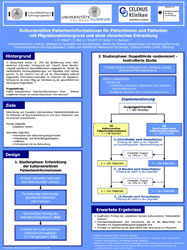
At the beginning of the project, the disease-specific patient information on depression and chronic lower back pain will be developed and translated into the target languages. This standard-translated patient information will then be modified in focus groups taking into account migration-, language-, and culture-specific aspects and developed further into culture-sensitive versions of patient information. The participating GPs will be sought out by the four centre coordinators in their practices, from where they will be instructed with regard to implementing the study. Following this, they will be provided with the patient information in the languages relevant to the study. The randomisation and survey of the patients takes place in the leading study centre in Freiburg.
Expected results
The study will provide an empirically tested answer to the question of whether culture-sensitive patient information is evaluated as more useful by migrants than translated information materials without cultural adaptation.
Current status of the project (July 2012)
- Creation of disease-specific patient information is completed
- Standard translation of patient information is completed
- Focus groups have been conducted
- Evaluation of focus groups is ongoing
< HOMECIMT - Barzel