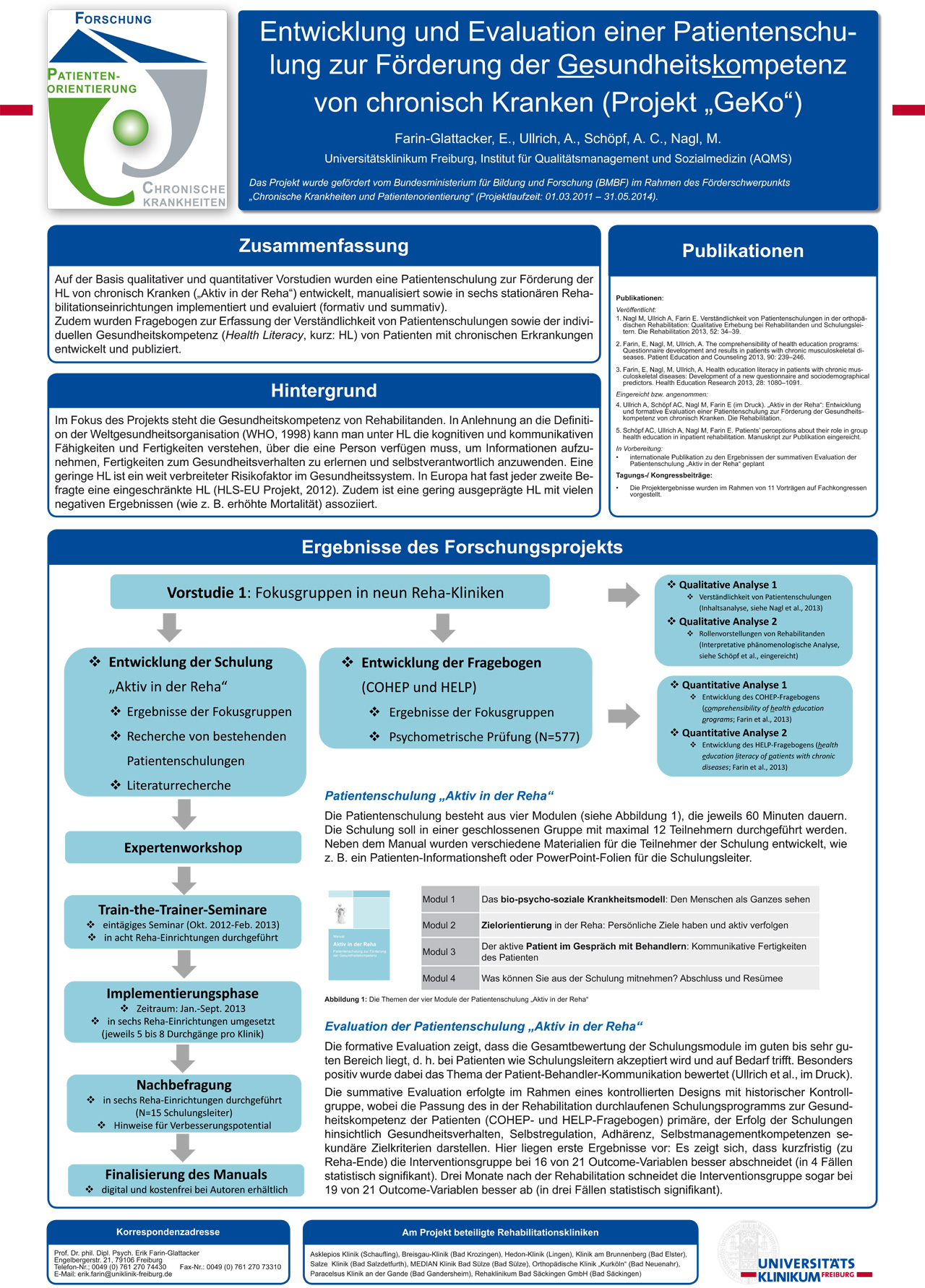
Development and evaluation of a patient education program to foster health literacy of the chronically ill (GeKo project)
Running time: March 2011 – May 2014
Objectives
The focus of the project is on health literacy ( abbreviation: HL) of rehabilitees, i.e. those cognitive and communicative abilities and skills which a person must possess in order – in interaction with motivational and volitional factors – to absorb information from patient education programs, learn skills regarding health behaviour, apply them in a self-responsible manner and to maintain corresponding behaviour. Concrete skills and requirements which are important in this context are, for instance, knowledge of fundamental medical and rehabilitation-related specialist terms and concepts (e.g. "cardiovascular system", "participation"), knowledge regarding the basic structure of the healthcare system, the understanding of simple medical texts, the processing of basic numerical information such as risk values, skills for self-responsible procurement of medical information and social-communicative competencies in dealing with treatment providers. The objective of the project consists of developing and evaluating a health education program attuned to the particular needs of rehabilitees with low HL, which facilitate the participants in drawing benefit from other patient education programs. In the framework of this project, moreover, a patient questionnaire will be developed and psychometrically tested, which measures the perceived fit between patient-perceived comprehensibility of health education programs and patient health literacy (abbreviation: HALEDU questionnaire, for fit between health literacy and health education).
Project plan and design
Qualitative pre-study 1: Interviews of patients and training leaders through focus groups (8 patient and 4 training leader focus groups). Aim: Hints regarding setting of priorities, conception and implementation of the health education program to be developed and determination of the contents of the HALEDU questionnaire to be developed.
Qualitative pre-study 2: Individual interviews with N=10 patients. Aim: Check the HALEDU questionnaire in terms of comprehensibility and acceptance.
Quantitative pre-study: Survey of N=250 patients with questionnaires (measurement time point: end of rehab). Aim: Determine the psychometric properties of the HALEDU questionnaire.
Development phase of the HL education program: Development of a first conception of the program on the foundation of insights from the qualitative pre-study 1 and from approaches from the literature. Presentation and discussion of the program concept in the framework of an expert workshop. Aim: Development and manualisation of the HL education program. Subsequently – to prepare the implementation – conducting of train-the-trainer seminars in the clinics participating in the project.
Main study: The main study constitutes a controlled study with a historical control group. Both in the baseline phase and in the intervention phase, data are gathered at the beginning of rehab, at the end of rehab and 3 months after the end of rehabilitation. Primary target criteria are the fit of the health education program undertaken in the rehabilitation with the patients' own HL (operationalised through the HALEDU questionnaire) and the general evaluation of the program (usefulness, relevance etc., operationalised through the heiQ questionnaire). The secondary target criteria are formed by the parameters, which depict the success of the training program in the rehabilitation in general (i.e. health behaviour, self-regulation, adherence etc.). As the statistical control of the confounders is particularly important in a non-randomised study, in the framework of the data analysis, a focus is set on the application of modern analytical procedures. In the project, two analytical methods with different advantages and disadvantages are employed: propensity scores and growth curve models. Patients with chronic back pain or arthrosis are included in the study. 9 rehabilitation clinics are participating in the project (see www.aqms.de).
Written publications
- Nagl M, Ullrich A, Farin E. Verständlichkeit von Patientenschulungen in der orthopädischen Rehabilitation: Qualitative Erhebung bei Rehabilitanden und Schulungsleitern. Die Rehabilitation 2013, 52:34–39.
- Farin, E, Nagl, M, Ullrich, A. The comprehensibility of health education programs: Questionnaire development and results in patients with chronic musculoskeletal diseases. Patient Education and Counseling 2013, 90(2):239–246.
- Farin, E, Nagl, M, Ullrich, A. Health education literacy in patients with chronic musculoskeletal diseases: Development of a new questionnaire and sociodemographical predictors. Health Education Research 2013, 28(6): 1080–1091.
- Ullrich A, Schöpf AC, Nagl M, Farin E (im Druck). „Aktiv in der Reha“: Entwicklung und formative Evaluation einer Patientenschulung zur Förderung der Gesundheits-kompetenz von chronisch Kranken. Die Rehabilitation.
- Schöpf AC, Ullrich A, Nagl M, Farin E. Patients’ perceptions about their role in group health education in inpatient rehabilitation (submitted).
Conference/congress contributions
- Nagl M, Ullrich A, Farin-Glattacker E: Die Verständlichkeit von Patientenschulungen in der Rehabilitation: Ergebnisse aus Patientenfokusgruppen. DRV-Schriften, 2012; 98: 154-155 (21. Rehabilitationswissenschaftliches Kolloquium/ 05.-07.3.2012 in Hamburg/ DRV Bund und DRV Nord), Deutsche Rentenversicherung Bund (Hrsg.).
- Nagl M, Ullrich A, Farin-Glattacker E: Die Verständlichkeit von Patientenschulungen als Kontextfaktor von Gesundheitskompetenz. Deutsche Medizinische Wochenschrift 2012; 137 (S3): 103-104 [11. Deutscher Kongress für Versorgungsforschung & 4. Nationaler Präventionskongress/27.-29.09.2012 in Dresden/ Deutschen Gesellschaft für Zahn-, Mund und Kieferheilkunde (DGZMK) gemeinsam mit dem Deutschen Verband für Gesundheitswissenschaften und Public Health (DVGPH) und dem Deutschen Netzwerk Versorgungsforschung (DNVF)].
- Ullrich A, Nagl M, Farin-Glattacker E: „Aktiv in der Reha“: Eine patientenorientierte Schulung zur Förderung der Gesundheitskompetenz bei chronisch Kranken. DRV-Schriften, 2013; 101: 225-226 (22. Rehabilitationswissenschaftliches Kolloquium/ 04.-06.03.2013 in Mainz/ DRV Bund und DRV Rheinland-Pfalz), Deutsche Renten-versicherung Bund (Hrsg.).
- Farin-Glattacker E, Ullrich A, Nagl M: Die Verständlichkeit von Patientenschulungen in der Rehabilitation. DRV-Schriften, 2013; 101: 223-224 (22. Rehabilitationswissenschaftliches Kolloquium/04.-06.03.2013 in Mainz/ DRV Bund und DRV Rheinland-Pfalz), Deutsche Rentenversicherung Bund (Hrsg.).
- Schöpf AC, Ullrich A, Nagl M, Farin E: Wie Patienten ihre Rolle in Patientenschulungen erleben – eine qualitative Analyse im Bereich muskuloskelettaler Erkrankungen. Düsseldorf: German Medical Science GMS Publishing House; 2013. DocT1-24-35 (12. Deutscher Kongress für Versorgungsforschung. Berlin, 23.-25.10.2013).
- Farin E, Ullrich A, Nagl M, Schöpf AC: Gesundheitskompetenz bezüglich edukativer Interventionen bei Patienten mit chronischen muskuloskelettalen Erkrankungen. Düsseldorf: German Medical Science GMS Publishing House; 2013. DocFV11-26 (12. Deutscher Kongress für Versorgungsforschung. Berlin, 23.-25.10.2013).
- Farin-Glattacker E, Ullrich A, Nagl M, Schöpf AC: Verständlichkeit von Patienten-schulungen und die Gesundheitskompetenz von Rehabilitanden. (Rehabilitationswissenschaftliches Seminar an der Universität Würzburg, Abteilung für Medizinische Psychologie und Psychotherapie, Medizinische Soziologie und Rehabilitationswissenschaften, Würzburg, 26.6.2013).
- Ullrich A, Nagl M, Schöpf AC, Farin-Glattacker E. “Aktiv in der Reha”: Eine patien-tenorientierte Schulung zur Förderung der Gesundheitskompetenz bei chronisch Kranken. (Symposium des Netzwerks Rehabilitationsforschung in Bayern e.V. (NRFB), Augsburg, 14.11.2013).
- Schöpf AC, Ullrich A, Nagl M, Farin E: Patientenbewertungen von Schulungen in der orthopädischen Rehabilitation – Ergebnisse einer qualitativen Freitextanalyse. DRV-Schriften, 2014; 103: 298-300 (23. Rehawissenschaftliches Kolloquium/10.03.-12.03.2014 in Karlsruhe/DRV Bund und DRV Baden-Württemberg), Deutsche Rentenversicherung Bund (Hrsg.).
- Ullrich A, Schöpf AC, Nagl M, Farin E: Ergebnisse der formativen Evaluation einer patientenorientierten Schulung zur Förderung der Gesundheitskompetenz bei chronisch Kranken („Aktiv in der Reha“). DRV-Schriften, 2014; 103: 291-293 (23. Reha-wissenschaftliches Kolloquium/ 10.03.-12.03.2014 in Karlsruhe/ DRV Bund und DRV Baden-Württemberg), Deutsche Rentenversicherung Bund (Hrsg.).
- Ullrich A, Schöpf AC, Nagl M, Farin E. Eine Patientenschulung zur Förderung der Gesundheitskompetenz für chronisch Kranke. (Fachtagung Gesundheitspädagogik in Forschung und Praxis/ 17.-18.10.2014 in Freiburg/ Pädagogische Hochschule Freiburg).
< NaKo - Watzke | PATENT - Körner >