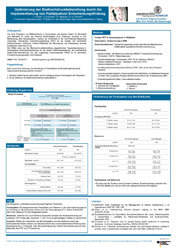
Optimisation of blood pressure control through physician training in the implementation of shared decision making in blood pressure patients in South Baden
Iris Tinsel1, Achim Siegel1, Thorsten Dürk1, Andreas Loh1, Wilhelm Niebling1, Karl-Georg Fischer2
1 Lehrbereich Allgemeinmedizin, Universitätsklinikum Freiburg
2 Med. Universitätsklinik Freiburg, Abt. Nephrologie und Allgemeinmedizin
High blood pressure is an important risk factor for cardiovascular diseases, which in turn represent the most frequent causes of death in industrial societies. Around 60% of patients who receive medication for arterial hypertension have blood pressure values that exceed the recommended threshold of 140/90 mmHg – despite medication. It can be assumed that the majority of these so-called "non-controlled-treated" patients are not capable of taking medication according to prescription and/or of implementing lifestyle changes.
Non-controlled-treated hypertension and the resulting cardiovascular diseases lead to high individual and societal costs. A stronger participation of patients in therapeutic decisions in the physician's practice can positively influence the treatment.
One concept with which to foster the participation of patients is that of "shared decision making" (SDM): On the basis of a mutual exchange of information, a consensus should be reached between patient and physician as equal interaction partners regarding the preferred treatment and its implementation. For the implementation of SDM, specific communication abilities of the physician are important. These can be trained in evaluated SDM physician training sessions.
By means of a cluster-randomised controlled study (cRCT), the aim is to examine whether, in patients with non-controlled-treated hypertension, blood pressure can be better lowered by means of an SDM physician training (intervention) than on the basis of a conventional treatment (control).
Primary endpoints are the changes of (1) the perceived participation (SDM-Q-9) and (2) the systolic bloodpressure (24-hr mean value).
Secondary endpoints are the changes of (1) the diastolic blood pressure (24-hr mean value), (2) the knowledge regarding hypertension (self-development), (3) adherence (MARS-D and Medication Possession Ratio [MPR]) and (4) the cardiovascular 10-year risk (CVR).
Between T0 and T3, the following data were recorded: 24-hr blood pressure measurements by means of outpatient blood pressure monitoring (ABPM), blood pressure measurements in the physicians' practice, cholesterol, HbA1c, comorbidities, calculation of the CVR (algorithm of the GP cardiovascular risk calculator arriba, data on medication prescription (MPD) of the GKV [statutory health insurers] and medication plans, patient surveys: perceived participation (SDM-Q-9), adherence (MARS-D), knowledge about the disease (self-development), autonomy preference index (API), trust in the physician (TPS), social support in taking medication, intention-to-treat hypertension index, sociodemographics, known genetic disposition for cardiovascular diseases, information provided by the patients on weight and size as well as on tobacco consumption.
In this cRCT, patients with medication-treated hypertension from 36 GP practices were included. The intervention group comprises 17 physicians' practices with 20 physicians. These took part after the baseline survey (T0) in a training session on shared decision making (SDM). The patients of the control group received treatment as usual (N=19 practices).
The evaluated SDM physician training of at least 2x3 hours was adapted to the treatment of hypertension. Content: Foundations of hypertension, communication theory and action steps of SDM, role plays with case examples, in which the application of a decision table developed specifically for the study was practised. The training was evaluated and a final learning check took place.
Following the training, physicians of the intervention group received patient information of the DEGAM [German College of General Practitioners and Family Physicians] on the themes of high blood pressure, tobacco cessation, healthy eating and active exercise to pass on to the patients.
Between June and December 2009, data of 1357 patients with a repeat prescription for antihypertensive drugs were gathered. Of these patients, N=1120 (82.5%) remained in the study due to exceeding the threshold values in the ABDM and/or an existing secondary diagnosis (diabetes mellitus, CHD/heart attack, stroke/TIA, PAOD). The data collection was concluded in September 2011.
The data presented in the following refer to the whole sample:
The preference to participate in the medical decision (API) was very low, with a mean value of 13.80 at T0 (SD=18.34) on a scale from 0 (no preference) to 100 (highest preference). Nevertheless, following the consultation to discuss the first ABDM, the patients indicated a high participation (SDM-Q-9), with a mean value of 71.8 (SD=19.07) on a scale from 0 (no participation) to 100 (highest participation). The self-assessment of the adherence (MARS-D) at T0 was very high, with a mean value of 93.7 (SD=10.0) on a scale from 0 (no adherence) to 100 (highest adherence). The analysis of the MPD, which is based on the comparison of the data on medication prescription with the medication plans, is not yet concluded. However, differences to the MARS-D are indicated.
The mean 24-hr blood pressure values was reduced in the total sample following therapy adjustment owing to the first ABDM by an average of 3.4/2.4 mmHg to 127.9/78.0 mmHg in the ABPM.
The mean cardiovascular 10-year risk of the study participants at T0 amounted to 21.56 % (SD = 18.15) and is thus clearly higher than the CVR of an age- and gender-adjusted average population (10.56 %; SD = 5.61).
The evaluations of the main analysis are currently ongoing. The results on the intervention effects will be published.
Conference contributions
- Tinsel et al.: Implementation of shared decision
making by physician training to optimise hypertension treatment. Study
protocol of a cluster-RCT. BMC Cardiovascular Disorders 2012 12:73. - Tinsel I, Niebling W, Fischer KG, Dürk T, Buchholz A: Zusammenhänge zur wahrgenommenen Patientenpartizipation bei medizinischen Entscheidungen in der hausärztlichen Behandlung von Patienten mit Bluthochdruck in Südbaden 2011: 114-115 (45. Kongress für Allgemein- und Familienmedizin (DEGAM)), Forum Medizin 21& Paracelsus Medizinische Privatuniversität Salzburg (Hrsg). (download: http://www.egms.de/en/meetings/fom2011/11fom153.shtml)
- Bösch M, Tinsel I, Buchholz A, Dürk T, Fischer KG, Niebling W: Die medikamentöse Behandlung von Patienten mit arterieller Hypertonie in der Hausarztpraxis – ein Abgleich mit bestehenden Leitlinienempfehlungen 2011; DEGAM: 23-24 (45. Kongress für Allgemein- und Familienmedizin (DEGAM)), Forum Medizin 21& Paracelsus Medizinische Privatuniversität Salzburg (Hrsg). (download: http://www.egms.de/en/meetings/fom2011/11fom014.shtml)
- Buchholz A, Spiegler St, Tinsel I, Fischer KG, Niebling W: Die Rolle von Depressivität in der Optimierung der Behandlung von Patienten mit Bluthochdruck 2011; DEGAM: 34-35 (45. Kongress für Allgemein- und Familienmedizin (DEGAM)), Forum Medizin 21& Paracelsus Medizinische Privatuniversität Salzburg (Hrsg). (download: http://www.egms.de/en/meetings/fom2011/11fom032.shtml)
- Tinsel I, Buchholz A, Niebling W, Fischer KG, Loh A: SDM training for General Practitioners in the Treatment of Arterial Results of a randomized controlled trial to evaluate the training effects ISDM 2011 Maastricht Abstractbook, 2011; Poster 202: 122 (ISDM Conference Maastricht), Caphri, University Maastricht (Hrsg). (download: http://www.isdm2011.org
- Tinsel I, Buchholz A, Pfaff A, Schardt T, Bollmann C, Niebling W, Fischer KG, Loh A: Association between patient rated amount of participation in Decision-Making outcome in patients with hypertension in General Practice ISDM 2011 Maastricht Abstractbook, 2011; Poster 200: 122 (ISDM Conference Maastricht), Caphri, University Maastricht (Hrsg). (download: http://www.isdm2011.org/ISDM_2011_ABSTRACT_BOOKDEF.pdf)
- Füller M, Niebling W, Fischer KG, Loh A, Beck S, Böhme K, Dürk T, Buchholz A, Tinsel I: Stellenwert der Patientenmotivation in der hausärztlichen Hypertonietherapie. Z Allg Med, 2010; DEGAM: 90-91-P2-1-6 (44. Kongress für Allgemeinmedizin und Familienmedizin in Dresden), Deutscher Ärzte Verlag (Hrsg). (download: http://www.degam.de/fileadmin/user_upload/degam/Kongresse/44.Kongress/44.Kongress_ZFA_Sonderausgabe_Abstractband.pdf)
- Tinsel I, Füller M, Fischer KG, Niebling W, Beck S, Böhme K, Dürk T, Loh A: Hypertensive Patienten mit multiplen kardiovaskulären Risikofaktoren. Welche Patienteneigenschaften tragen dazu bei Partizipative Entscheidungsfindung (PEF) erfolgreich umzusetzten? Ergebnisse einer quantitativen Studie. 2010; EbM: 71 (11. EbM-Jahrestagung Salzburg 2010), EbM - ein Gewinn für die Arzt-Patient-Beziehung? Forum Medizin21 & 11. EbM-Jahrestagung des Deutschen Netzwerks Evidenzbasierte Medizin (Hrsg). : http://dx.doi.org/10.3205/10ebm105
- Tinsel I, Loh A, Niebling W, Böhme K, Beck S, Buchholz A, Fischer KG: Praxisblutdruckmessung - eine adäquate Methode zur Einschätzung der Behandlungsrealität in der hausärztlichen Bluthochdruckbehandlung? Z Allg Med, 2010; DEGAM: 54, S 6-4 (44. Kongress für Allgemeinmedizin und Familienmedizin in Dresden), Deutscher Ärzte Verlag (Hrsg). (download: http://www.degam.de/fileadmin/user_upload/degam/Kongresse/44.Kongress/44.Kongress_ZFA_Sonderausgabe_Abstractband.pdf
- Tinsel I, Beck S, Fischer KG, Niebling W, Böhme K, Loh A, Dürk T: Optimierung der Blutdruckbehandlung durch Partizipative Entscheidungsfindung. Erste Ergebnisse einer cluster-randomisierten Interventionsstudie. Z Allg Med, 2009; DEGAM: 149-150 (43. Kongress für Allgemeinmedizin und Familienmedizin), Deutscher Ärzte-Verlag (Hrsg). (download: http://www.degam.de/dokumente/Kongresse/Hauptprogramm_mit_Abstractband.pdf)
- Tinsel I, Hoffmann A, Beck S, Fischer KG, Niebling W, Böhme K, Loh A, Dürk T: Geringe Compliance bei arterieller Hypertonie. Eine Frage des medizinischen Entscheidungsmodells? Eine quantitative Pilotstudie Z Allg Med, 2009; DEGAM: 211-212 (43. Kongress für Allgemeinmedizin und Familienmedizin), Deutscher Ärzte-Verlag (Hrsg). (download: http://www.degam.de/dokumente/Kongresse/Hauptprogramm_mit_Abstractband.pdf)
< Risk-adapted patient information ... - Kohlmann