Rehabilitation aftercare – "Neues Credo" for
rehabilitation clinics (NaSo 1)
Project information
Grant recipient:
Universität zu Lübeck, Institut für Sozialmedizin
Project leader:
Dr. Ruth Deck, Dr. Angelika Hüppe
Project implementation:
Dipl. Psych. Susanne Schramm
Project running time:
01.01.2008-01.07.2011
Funding code:
0421-FSCP-0549
Cooperating clinics:
- Nordsee-Reha-Klinik II (St. Peter-Ording)
- Mühlenbergklinik (Bad Malente)
- Klinikum Bad Bramstedt
- Ostseeklinik (Schönberg-Holm)
- Asklepios Klinik (Bad Schwartau)
- Buchenholm Vital-Kliniken GmbH (Bad Malente)
Background and research question:
Prompted by studies and overview works showing that the short-term positive effects at the end of rehabilitation cannot be consolidated over a longer period of time (6-12 months after the end of rehab) (e.g. Hüppe & Raspe 2003, 2005), the theme of "aftercare" or the optimisation of rehab aftercare has gained in importance (Köpke 2005, Gerdes et al. 2005). With the "new creed" (Deck et al. 2009), an aftercare strategy for rehabilitees [1] with chronic back pain (CBP) was developed, which focuses – in addition to the initial phase (inpatient rehab) – on a "supported personal initiative" in the patients' home (transfer phase). The therapy components of this complex intervention, which was developed in a care-based manner (e.g. action planning, self-observation, documentation), are based on assumptions of theoretical modelling from health psychology (Schwarzer 2004).
The aim of the model project was to evaluate the aftercare concept, which focuses on the increase and consolidation of physical activity in the rehabilitees' daily lives. At the end of the institutional phase of rehabilitation, concrete action plans should be available regarding which physical activity should be regularly integrated into everyday life.
Methods:
The evaluation took place in the framework of a multi-centre, prospective, controlled study with three measurement time points (T0: beginning of rehab, T1: end of rehab, T2: 12-month follow-up). Rehabilitees with CBP as a primary diagnosis were included in the study (M51-M54 according to ICD-10)[2]. The participants of the intervention group (IG) implement the "new creed" in accordance with its premises (rehab process, see downloads): An important element of the institutional phase is the observation booklet "Moving rehab", which supports the process of will formation and action planning in the individual case. During the post-inpatient phase (12 months), the endeavour is to stabilise that which was achieved in rehab over a period of 12 months with the aid of three activity diaries (self-observation technique). The IG clinics were provided with a so-called aftercare representative for the running time of the project. The participants in the control group (CG) received standard care in accordance with the guidelines.
Primary target criteria were limitations in participation (IMET [Deck et al. 2008]), number of disability days (Korff et al. 1992), and functional impairments in everyday life (FFbH-R [Kohlmann & Raspe 1996]). Subjective health parameters (general state of health [GS]; SF-36: vitality; SCL-90R: somatization; FSS: catastrophising cognitions; GDS: General Depression Scale), performance capability, professional participation (SPE: subjective prognosis of employment ability, sick days: number of days of incapacity to work) and the degree of physical activity (according to Menink 1999) were defined a priori as secondary dependent variables. Moreover, variables for assuring treatment quality and for determining the usefulness and feasibility of the intervention were assessed.
The longitudinal analysis of the data ensued using multifactorial analyses of variance (Treatment [IG/CG]*time [T0, T1, T2]) controlling for potential differences in the starting situation; furthermore, both intra- and inter-group effect sizes were calculated. Due to multiple testing, the significance level was adjusted accordingly (alpha adjustment).
Results:
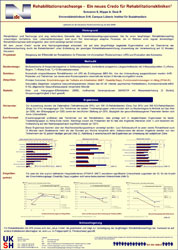
For the evaluation, the complete data of 166 IG rehabilitees (drop-out 41%) and 368 CG participants (drop-out 31%) were drawn on (completer analysis, participation rate 65%):
The rehabilitees of the IG are an average of 2 years younger than the CG (p=.008) and have a lower level of school-leaving qualification (p=.030). Furthermore, the rehabilitees of the two treatment groups differ significantly in terms of their occupational status (p=.001); for the health-related parameters, no statistically significant differences were found for the starting position survey [3].
At the 12-month follow-up, significant differences in favour of the IG were found for two of the three main dependent variables (FFbH-R, IMET): Interaction effect of treatment*time, each p<.001. With regard to the number of disability days, there were no differences between the treatment groups: interaction effect treatment*time, p=.199; this would appear to be attributable to the type of survey (operationalisation).
The results regarding the secondary target variables indicate significant differences between the treatment groups, with the rehabilitees benefiting to a greater degree over time: The respective effect estimates reach – with one exception [4] – moderate orders of magnitude and were confirmed by significant interaction effects. Moreover, rehabilitees of the IG reported significantly more often that they were able to achieve their subjective rehab goals (p<.01); sports-based prevention offers (participation in a sports club, in the fitness studio etc.) were utilised significantly more often (p<.01).
Conclusion:
For rehabilitees with CBP, the intervention according to the "new creed" contributes to consolidating rehab successes over a period of 12 months; the often cited "trough effect" within rehabilitation research (Hüppe & Raspe 2005) is shown to a much lower degree. On the whole, the results speak in favour of the effectiveness of the complex aftercare intervention [5]; nevertheless, in view of the study design, the results can only be assured to a limited degree. To derive a causal relationship, the results should be replicated in the framework of an RCT, the transfer to other indication areas should be checked and the corresponding analyses should be supplemented by economic evaluations. To embed the interaction in theoretical terms, the HAPA (the social-cognitive process model of health behaviour, Schwarzer 1992, 2004) is suggested; corresponding specifications of the individual intervention module/premises as well as the manualisation of the concept for standardised implementation are to be recommended.
Cited literature:
- Deck R, Muche-Borowski C, Mittag O et al. (2008): IMET – Index zur Messung von Einschränkungen der Teilhabe. In: Bengel J, Wirtz M, Zwingmann C (Hrsg): Diagnostische Verfahren in der Rehabilitation. Göttingen: Hogrefe:372-374.
- Deck R, Hüppe A, Arlt AC (2009): Optimierung der Rehabilitationsnachsorge durch eine längerfristige Begleitung der Rehabilitanden – Ergebnisse einer Pilotstudie. Rehabilitation 48:39-46.
- Gerdes N, Bührlen B, Lichtenberg S et al. (2005): Rehabilitationsnachsorge: Analyse der Nachsorgeempfehlungen und ihrer Umsetzungen. Rehabilitationswissenschaften, Rehabilitationspsychologie, Rehabilitationsmedizin (Band 10). Regensburg: Roderer.
- Hüppe A & Raspe H (2003): Die Wirksamkeit stationärer medizinischer Rehabilitation in Deutschland bei chronischen Rückenschmerzen: eine systematische Literaturübersicht 1980 - 2001. Rehabilitation 42:143-154.
- Hüppe A & Raspe H (2005): Zur Wirksamkeit von stationärer medizinischer Rehabilitation in Deutschland bei chronischen Rückenschmerzen: Aktualisierung und methodenkritische Diskussion einer Literaturübersicht. Rehabilitation 44:24-33.
- Köpke KH (2005): Aufwerten, ausbauen und systematisieren - Eine Analyse von Situation, Reformbedarf und innovativen Projekten zur Nachsorge in der Rehabilitation der Rentenversicherung. Rehabilitation 44:344-352.
- Korff M von, Ormel J, Keefe FJ et al. (1992): Grading the severity of chronic pain. Pain 50:133-149.
- Kohlmann T & Raspe H (1996): Der Funktionsfragebogen Hannover zur alltagsnahen Diagnostik der Funktionsbeeinträchtigung durch Rückenschmerzen (FFbH-R). Rehabilitation 35:I-VIII.
- Mensink GBM (1999): Körperliche Aktivität. Gesundheitswesen 61 (Sonderheft 2):126-131.
- Schwarzer R (1992): Self-efficacy in the adoption and maintenance of health behaviours: Theoretical approaches and a new model. In: Schwarzer R (Hrsg.): Self-efficacy: Thought control of action. Bristol PA: Taylor & Francis:217-243.
- Schwarzer R (2004): Psychologie des Gesundheitsverhaltens. Eine Einführung in die Gesundheitspsychologie. Göttingen: Hogrefe.
Publications:
- Deck R, Schramm S, Hüppe A (2012): Begleitete Eigeninitiative nach der Reha („neues Credo") – ein Erfolgsmodell? Rehabilitation 51(2):ePub.
- Hüppe A, Schramm S, Deck R (2010): Der Weg zu einer „Gelebten Nachsorge" – „über 7 Brücken musst du gehen". In: Deck R, Glaser-Möller N, Remé T (Hrsg.): Schnittstellen der medizinischen Rehabilitation. Lage: Jacobs:91-100.
Abstracts:
- Deck R, Schramm S, Hüppe A, Raspe H (2011): Ein neues Credo für Rehabilitationskliniken – Ein möglicher Weg zur Steigerung der längerfristigen Effektivität der medizinischen Rehabilitation. DRV-Schriften 93:41-43.
- Schramm S, Deck R, Hüppe A, Raspe H (2009): Rehabilitationsnachsorge (NaSo)-Ein neues Credo für Rehabilitationskliniken: Konzeption und Durchführung des Modellprojekts. DRV-Schriften 83:37-38.
Funding award of the Celenus Kliniken GmbH 2011
< KAKo-Training - Mau | Materialien CREDO I - Deck >